
Quick answer: In the Shopify vs WooCommerce choice, Shopify is better for a fast, low-maintenance launch and international card sales, while WooCommerce is better for stores that need local payments like bKash and cash on delivery, custom features or strong content SEO. Shopify costs a monthly fee plus apps; WooCommerce is free but needs good hosting and maintenance.
I build online stores on both platforms. I have made custom Shopify themes in Liquid, and WooCommerce shops for clients in Bangladesh and Europe, from a wholesale market to a food brand to a small gift shop in Lithuania. Clients ask me the same question almost every week: should we use Shopify or WooCommerce? Here is the honest answer, based on what actually happens after launch, not on feature lists.
Table of Contents
Shopify vs WooCommerce: the short version
Shopify is a hosted platform. You pay a monthly fee and Shopify runs the servers, security and updates. WooCommerce is a free plugin that turns a WordPress site into a store. You own everything, but you, or your developer, look after hosting, updates and backups.
| Shopify | WooCommerce | |
|---|---|---|
| Who runs the store | Shopify (hosted) | You (self-hosted WordPress) |
| Starting cost | Basic plan: $29 a month billed yearly, $39 monthly | Free plugin; hosting from about $5 to $30 a month |
| Design freedom | Themes and Liquid code, inside Shopify limits | Any design, any feature, full code access |
| Content and SEO | Good basics, simpler blog | Full WordPress: blog, landing pages, Rank Math |
| Payments in Bangladesh | Shopify Payments not available; limited local options | bKash, Nagad, SSLCommerz, COD plugins |
| Maintenance | Very low | Regular updates and backups needed |
| Best for | Fast launch, small team, global sales | Content-led brands, custom features, local payments |
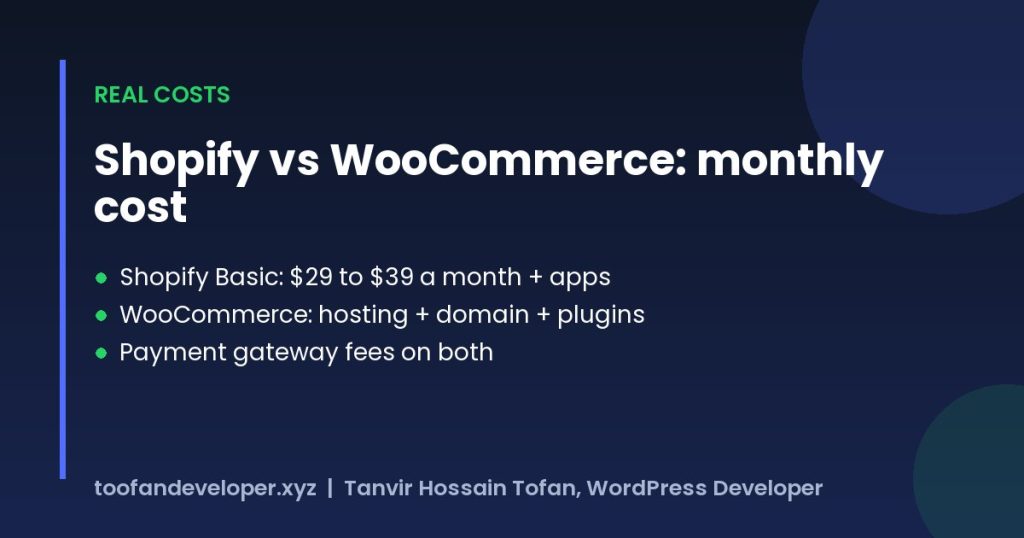
Cost: what you really pay each month
The plan price is only the start. On Shopify, most stores add paid apps for reviews, upsells, subscriptions or advanced filters, and those often cost $10 to $50 each per month. If you do not use Shopify Payments, Shopify also charges an extra fee on every sale on top of your payment gateway fee, up to 2% on the Basic plan. Check Shopify pricing for the current numbers in your country.
WooCommerce has no monthly platform fee, but good hosting matters. A store on cheap shared hosting with 40 plugins will be slow, and a slow store loses sales. Budget for proper hosting, a few premium plugins and some developer time for updates. Over two or three years the total is often similar; the difference is that WooCommerce costs are under your control.
Payments: the deciding factor for Bangladeshi stores
This is where many local businesses get stuck. Shopify Payments is not available in Bangladesh, so a Bangladeshi Shopify store depends on third-party gateways and pays the extra Shopify fee on each sale. On WooCommerce, bKash, Nagad, SSLCommerz and cash on delivery all have mature plugins, and most courier integrations for Steadfast, Pathao and RedX are built for WooCommerce first.
If you sell mainly to Bangladesh with COD and mobile banking, WooCommerce is usually the practical choice. If you sell to the US, UK or Europe with card payments, Shopify becomes much more attractive.
Design and custom features
Shopify themes look polished out of the box, and a developer can change almost anything in the theme with Liquid. What you cannot change is how Shopify itself works: checkout customisation is limited on lower plans, and complex rules such as wholesale pricing by customer group usually need an app.
With WooCommerce you can build anything WordPress can do. For one wholesale client I built minimum order quantities, bulk price tiers and a custom order flow directly in the theme, without a monthly app bill. The trade-off is that custom code needs someone who knows what they are doing. If you are weighing builders for the front end too, my ACF vs Elementor guide explains the options.
SEO and content
Both platforms can rank well. Shopify handles technical basics like sitemaps and canonical tags automatically, but its URL structure is fixed (/products/ and /collections/) and the blog is basic. WooCommerce runs on WordPress, which is still the strongest platform for content: guides, comparison pages and landing pages that bring in search traffic and point visitors to products. If your marketing plan depends on blogging and SEO, Shopify vs WooCommerce leans towards WooCommerce.
Speed and maintenance
Shopify stores are fast by default because Shopify runs the hosting and a global CDN, although too many apps can slow any theme. A WooCommerce store can be just as fast, but only with good hosting, caching and image optimization. I recently took a WordPress site from 30 to 99 on mobile PageSpeed; the full process is in my WordPress speed optimization case study.
Security follows the same pattern. Shopify patches the platform for you. On WooCommerce, outdated plugins are the most common way stores get hacked, so updates and backups are not optional. If it has already happened, follow my hacked WordPress cleanup checklist.
Which should you choose?
Choose Shopify if:
- You want to launch quickly and do not want to think about hosting or updates.
- You sell internationally with card payments.
- Your team is small and non-technical, and a monthly fee is fine.
Choose WooCommerce if:
- You sell in Bangladesh with bKash, Nagad, SSLCommerz or cash on delivery.
- You need custom features, wholesale rules or a unique checkout flow.
- Content and SEO are a big part of how you get customers.
- You want to own your store and avoid per-sale platform fees.
Already on one and thinking of switching? Migration is possible both ways, but plan redirects for every product URL so you do not lose your Google rankings.
How much does it cost to build each one?
A simple Shopify store with a customised theme or a WooCommerce shop with 10 to 50 products usually takes three to six weeks. See real price ranges in my WordPress development cost guide and my services page, or browse stores I have built.
Frequently asked questions
Is Shopify or WooCommerce better for a small business?
For a small team that wants to sell quickly with card payments, Shopify is simpler. For a small business in Bangladesh that relies on cash on delivery and mobile banking, WooCommerce is usually more practical and cheaper per sale.
Is WooCommerce really free?
The plugin is free. You still pay for hosting, a domain, and often a few premium plugins and developer time for updates.
Can I use bKash with Shopify?
Shopify Payments is not available in Bangladesh, so you need a third-party gateway app, and Shopify adds its own extra fee on each sale. Check that your gateway supports Shopify before you choose the platform.
Which is better for SEO, Shopify or WooCommerce?
Both can rank. WooCommerce runs on WordPress, so it is stronger for blogs, guides and landing pages; Shopify handles technical basics automatically but is less flexible with URLs and content.
Can I move from WooCommerce to Shopify or back later?
Yes. Products, customers and orders can be migrated either way. The important part is setting 301 redirects for old product and category URLs so you keep your search traffic.
Not sure which one fits your store? Tell me about your products and customers and I will recommend one honestly, with a fixed quote, or message me on WhatsApp.